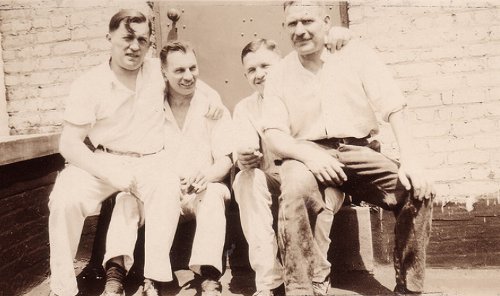
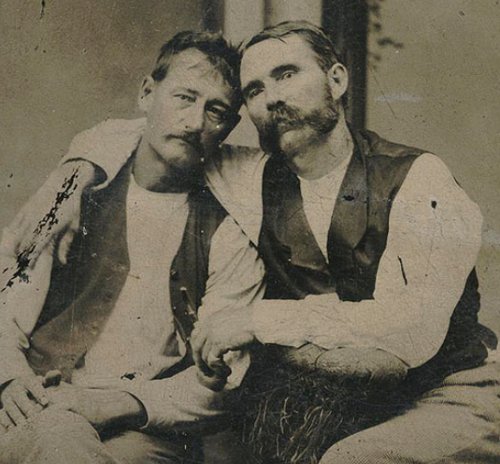
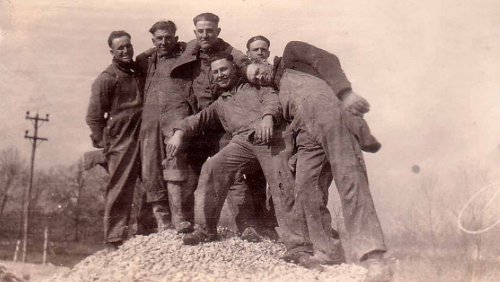
As you make your way through the photos below, many of you will undoubtedly feel a keen sense of surprise — some of you may even recoil a bit as you think, “Holy smokes! That’s so gay!”
The poses, facial expressions, and body language of the men below will strike the modern viewer as very gay indeed. But it is crucial to understand that you cannot view these photographs through the prism of our modern culture and current conception of homosexuality. The term “homosexuality” was in fact not coined until 1869, and before that time, the strict dichotomy between “gay” and “straight” did not yet exist. Attraction to, and sexual activity with other men was thought of as something you did, not something you were. It was a behavior — accepted by some cultures and considered sinful by others.
But at the turn of the 20th century, the idea of homosexuality shifted from a practice to a lifestyle and an identity. You did not have temptations towards a certain sin, you were a homosexual person. Thinking of men as either “homosexual” or “heterosexual” became common. And this new category of identity was at the same time pathologized — decried by psychiatrists as a mental illness, by ministers as a perversion, and by politicians as something to be legislated against. As this new conception of homosexuality as a stigmatized and onerous identifier took root in American culture, men began to be much more careful to not send messages to other men, and to women, that they were gay. And this is the reason why, it is theorized, men have become less comfortable with showing affection towards each other over the last century. At the same time, it also may explain why in countries with a more conservative, religious culture, such as in Africa or the Middle East, where men do engage in homosexual acts, but still consider homosexuality the “crime that cannot be spoken,” it remains common for men to be affectionate with one another and comfortable with things like holding hands as they walk.
Whether the men below were gay in the way our current culture understands that idea, or in the way that they themselves understood it, is unknowable. What we do know is that the men would not have thought their poses and body language had anything at all to do with that question. What you see in the photographs was common, not rare; the photos are not about sexuality, but intimacy.
These photos showcase an evolution in the way men relate to one another — and the way in which certain forms and expressions of male intimacy have disappeared over the last century.
It has been said that a picture tells a thousand words, so while I have provided a little commentary below, I invite you to interpret the photos yourselves, and to ask and discuss questions such as: “Who were these men?” “What was the nature of their relationships?” “Why has male intimacy decreased and what are the repercussions for the emotional lives of men today?”
From the Civil War through the 1920’s, it was very common for male friends to visit a photographer’s studio together to have a portrait done as a memento of their love and loyalty. Photographers would offer various backgrounds and props the men could choose from to use in the picture. Sometimes the men would act out scenes; sometimes they’d simply sit side-by-side; sometimes they’d sit on each other’s laps or hold hands. The men’s very comfortable and familiar poses and body language might make the men look like gay lovers to the modern eye — and they could very well have been — but that was not the message they were sending at the time. The photographer’s studio would have been at the center of town, well-known by everyone, and one’s neighbors would having been sitting in the waiting room just a few feet away. Because homosexuality, even if thought of as a practice rather than an identity, was not something publicly expressed, these men were not knowingly outing themselves in these shots; their poses were common, and simply reflected the intimacy and intensity of male friendships at the time — none of these photos would have caused their contemporaries to bat an eye.
Life asks you the meaning of life; you don’t ask life. You are questioned by life. It’s not what you expect from life, but what life expects from you.
1. “Ultimately, man should not ask what the meaning of his life is, but rather he must recognize that it is he who is asked. In a word, each man is questioned by life; and he can only answer to life by answering for his own life; to life he can only respond by being responsible.”
2. “It did not really matter what we expected from life, but rather what life expected from us. We needed to stop asking about the meaning of life, and instead to think of ourselves as those who were being questioned by life daily and hourly…Life ultimately means taking the responsibility to find the right answer to its problems and to fulfill the tasks which it constantly sets for each individual.”
Love is the ultimate and the highest goal to which you can aspire.
3. The truth—that love is the ultimate and the highest goal to which man can aspire…The salvation of man is through love and in love.
4. Love goes very far beyond the physical person…It finds its deepest meaning in his spiritual being, his inner self.
Self-actualization is possible only as a side-effect of self-transcendence.
5. “‘The self-transcendence of human existence’…being human always points, and is directed, to something, or someone, other than oneself—be it a meaning to fulfill or another human being to encounter. The more one forgets himself—by giving himself to a cause to serve or another person to love—the more human he is and the more he actualizes himself…self-actualization is possible only as a side-effect of self-transcendence.”
Happiness cannot be pursued; it must ensue as a side-effect of a reason to be happy.
6. “Don’t aim at success—the more you aim at it and make it a target, the more you are going to miss it. For success, like happiness, cannot be pursued; it must ensue, and it only does so as the unintended side-effect of one’s dedication to a cause greater than oneself or as the by-product of one’s surrender to a person other than oneself. Happiness must happen, and the same holds for success: you have to let it happen by not caring about it. I want you to listen to what your conscience commands you to do and go on to carry it out to the best of your knowledge. Then you will live to see that in the long run—in the long run, I say!—success will follow you precisely because you had forgotten to think of it.”
7. “Happiness cannot be pursued; it must ensue. One must have a reason to ‘be happy.’ Once the reason is found, however, one becomes happy automatically. As we see, a human being is not one in pursuit of happiness but rather in search of a reason to become happy, last but not least, through actualizing the potential meaning inherent and dormant in a given situation.”
The meaning of life is unique to each moment; no situation repeats itself.
8. “For the meaning of life differs from man to man, from day to day and from hour to hour. What matters, therefore, is not the meaning of life in general but rather the specific meaning of a person’s life at a given moment.”
9. “These tasks, and therefore the meaning of life, differ from man to man, and from moment to moment. Thus it is impossible to define the meaning of life in a general way. Questions about the meaning of life can never be answered by sweeping statements. ‘Life’ does not mean something vague, but something very real and concrete, just as life’s tasks are also very real and concrete. They form man’s destiny, which is different and unique for each individual. No man and no destiny can be compared with any other man or any other destiny. No situation repeats itself, and each situation calls for a different response. Sometimes the situation in which a man finds himself may require him to shape his own fate by action. At other times it is more advantageous for him to make use of an opportunity for contemplation and to realize assets in this way. Sometimes man may be required simply to accept fate, to bear his cross. Every situation is distinguished by its uniqueness, and there is always only one right answer to the problem posed by the situation at hand.”
10. “Thus far we have shown that the meaning of life always changes, but that it never ceases to be. According to logotherapy, we can discover this meaning in life in three different ways: (1) by creating a work or doing a deed; (2) by experiencing something or encountering someone; and (3) by the attitude we take toward unavoidable suffering.”
The meaning of life is unique to each individual; no one can be replaced.
11. “Man’s search for meaning is the primary motivation in his life and not a ‘secondary rationalization’ of instinctual drives. This meaning is unique and specific in that it must and can be fulfilled by him alone; only then does it achieve a significance which will satisfy his own will to meaning.”
12. “One should not search for an abstract meaning of life. Everyone has his own specific vocation or mission in life to carry out a concrete assignment which demands fulfillment. Therein he cannot be replaced, nor can his life be repeated. Thus, everyone’s task is as unique as is his specific opportunity to implement it.”
13. “This uniqueness and singleness which distinguishes each individual and gives a meaning to his existence has a bearing on creative work as much as it does on human love. When the impossibility of replacing a person is realized, it allows the responsibility which a man has for his existence and its continuance to appear in all its magnitude. A man who becomes conscious of the responsibility he bears toward a human being who affectionately waits for him, or to an unfinished work, will never be able to throw away his life. He knows the ‘why’ for his existence, and will be able to bear almost any ‘how.’”
Human beings are self-determining; meaning is your responsibility to actualize.
14. “A human being is not one thing among others; things determine each other, but man is ultimately self-determining. What he becomes—within the limits of endowment and environment—he has made out of himself…Man has both potentialities within himself; which one is actualized depends on decisions but not on conditions.”
15. “Man is not fully conditioned and determined but rather determines himself whether he gives in to conditions or stands up to them. In other words, man is ultimately self-determining. Man does not simply exist but always decides what his existence will be, what he will become in the next moment. By the same token, every human being has the freedom to change at any instant.”
16. “This emphasis on responsibleness is reflected in the categorical imperative of logotherapy, which is: ‘Live as if you were living already for the second time and as if you had acted the first time as wrongly as you are about to act now!’ It seems to me that there is nothing which would stimulate a man’s sense of responsibleness more than this maxim, which invites him to imagine first that the present is past and, second, that the past may yet be changed and amended. Such a precept confronts him with life’s finiteness as well as the finality of what he makes out of both his life and himself.”
17. “Freedom, however, is not the last word. Freedom is only part of the story and half of the truth. Freedom is but the negative aspect of the whole phenomenon whose positive aspect is responsibleness. In fact, freedom is in danger of degenerating into mere arbitrariness unless it is lived in terms of responsibleness. That is why I recommend that the Statue of Liberty on the East Coast be supplemented by a Statue of Responsibility on the West Coast.”
18. “What then is man? Thus we ask the question again. He is a being that always decides what it is. A being that has within it at one and the same time the possibility of sinking to the level of an animal or of soaring to a life of near-holiness. Man is that being which invented the gas chambers; but he is at the same time that being which walked with head held high into these very same gas chambers, the Lord’s Prayer or the Jewish prayer for the dead on his lips.”
No matter the circumstance, you always have the last of the human freedoms: to choose your attitude.
19. “Everything can be taken from a man but one thing: the last of the human freedoms—to choose one’s attitude in any given set of circumstances, to choose one’s own way.”
20. “To be sure, a human being is a finite thing, and his freedom is restricted. It is not freedom from conditions, but it is freedom to take a stand toward the conditions.”
Tension, striving, and struggling for a worthwhile goal are positive; trying to close the gap between what one is and what one should become.
21. “Thus it can be seen that mental health is based on a certain degree of tension, the tension between what one has already achieved and what one still ought to accomplish, or the gap between what one is and what one should become. Such a tension is inherent in the human being and therefore is indispensable to mental well-being. We should not, then, be hesitant about challenging man with a potential meaning for him to fulfill. It is only thus that we evoke his will to meaning from its state of latency. I consider it a dangerous misconception of mental hygiene to assume that what man needs in the first place is equilibrium or, as it is called in biology, ‘homeostasis,’ i.e., a tensionless state. What man actually needs is not a tensionless state but rather the striving and struggling for a worthwhile goal, a freely chosen task. What he needs is not the discharge of tension at any cost but the call of a potential meaning waiting to be fulfilled by him. What man needs is not homeostasis but what I call ‘noö-dynamics,’ i.e., the existential dynamics in a polar field of tension where one pole is represented by a meaning that is to be fulfilled and the other pole by the man who has to fulfill it.”
Life never ceases to have meaning; even suffering ceases to be suffering at the moment it finds a meaning.
22. “Human life, under any circumstances, never ceases to have a meaning, and that this infinite meaning of life includes suffering and dying, privation and death.”
23. “In some way, suffering ceases to be suffering at the moment it finds a meaning, such as the meaning of a sacrifice.”
24. “When a man finds that it is his destiny to suffer, he will have to accept his suffering as his task; his single and unique task. He will have to acknowledge the fact that even in suffering he is unique and alone in the universe. No one can relieve him of his suffering or suffer in his place. His unique opportunity lies in the way in which he bears his burden.”
25. “One may only demand heroism of one person, and that person is oneself.”
Austrian neurologist and psychiatrist Dr Viktor Frankl (1905 – 1997) attends the 6th International Congress of Psychotherapy in London, UK, August 1964. (Photo by Evening Standard/Hulton Archive/Getty Images)
This quote was from a TV program about obesity. The doctor that was being interviewed was slim, and very good looking.
He was talking about heart disease and obesity….when he suddenly said: it’s like feeling hungry is like a crime.
He was talking about the people he was treating for morbid obesity….and how these people treat hunger as if it was a crime…and to feel hungry had to be quickly treated with eating food.
Once upon a time there lived a proud lion. He loved life so much that he smiled almost all the time, showing his pearly white teeth.
One day he was frolicking through the deep African grass, when he came across a white dentist with a large gun.
The dentist was saying many things about how he wanted to shoot the lion, but in reality he was really very afraid of the lion.
He imagined what the lion’s head would look like hanging boldly on his dental surgery’s wall and all the patients would comment on the lion’s head, saying how brave the dentist was, and how exciting it must of been to have been there to witness the lion being shot, and how victorious the dentist was at his kill.
But this didn’t happen. In fact the dentist got so frightened when he saw the lion, he dropped the gun and ran in the opposite direction. The lion proceeded to chase the dentist. He ran and ran, but could not outrun the lion.
The lion did not hesitate but to kill and eat the dentist!
The lion could taste American hamburgers and mac and cheese. The dentist was so delicious that the lion roared with delight!
What a day the lion had. He went off to tell all the other lions about his kill. All the other lions came to taste the dentist. They were also delighted on how delicious the dentist was.
A week had passed, and a famous toothpaste manufacturer contacted the lion and asked him if he would like to be in a ad for toothpaste. The lion said YES.
The ad was a HUGE success an went on to be used and twenty other countries, as well as Africa. The ad showed kids all over the world, that if you eat well and healthy, you will have strong white teeth, just like the lion.
And if you also brush your teeth you will avoid having to go to a dentist who may very well want to shoot and kill you if he had the chance.And then put your head on a plaque and hang it on the wall of the surgery.
I suppose I would loosely say: I’m body, mind and spirit.
I include spirit because I feel that for me, spirit a big part of the puzzle of being human.
I’m overweight, and my doctor says I’m ‘obese’ because my BMI (Body Mass Index) is over 30.
Am I proud to be obese? No. Because I don’t equate my body with my identity.
But then maybe, I’m supposed to be proud of being obese(?) I’ve seen TV programs where very large women saying that they are ‘big and proud’.
It ‘seems’ that almost every ‘minority’ or ‘persecuted community’s’ response, is to become proud of being in that community.
I can’t really see any harm in doing that, but is that really necessary?
Sexuality
We have recently had ‘Pride Month’, which is a very positive thing for the LGBTIQ community and for all persons learning about inclusiveness.
I do not equate sexuality with identity, and I also do not equate sexuality with pride.
‘Desire, behaviour and identity are distinct, and they do not always overlap. Someone who is celibate may also have strong sexual desires or even a particular sexual identity; someone may identify as heterosexual but have homosexual experiences; most people will have sexual desires that are not necessarily acted out in practice.’
– Professor Dennis Altman.
…so I don’t understand when people say they are proud to be Gay etc.
I do understand when someone says: “I’m no longer feeling shameful about my sexuality”. Or “I no longer carry all the negative and hateful things that people have said to me about my sexuality”.
We do not choose to whom or what we are sexually attracted to. Even if someone is attracted to children, they don’t choose that for themselves. Sexuality is neither wrong or right it just is. It’s our behaviour that dictates whether something is wrong or right.
I’ve never heard Jeffery Epstein say that he was proud that he was attracted to children. (Remember its behaviour not sexual orientation that’s the issue). Apparently there are plenty of people out there who are attracted to children (men and women) who have never harmed a child.
Sexuality is a significant and a very important part of being human, but it’s not all that I am.
Being an older person my libido is almost non-existent, so sexuality is no longer that important to me. Whereas, when I was young, 20 to 33 years, sexuality was very significant, but I was never proud of it.
I like the way we talk about mental illness these days i.e. I have bipolar disorder, or I’m having a depressive episode. I have alcoholism…
…I am unhappy, becomes there is some unhappiness within me.
So what are examples of being proud?
I’m so proud of the way I brought up my children to respect other people.
I’m really proud of my willingness to get fit and lose weight.
I’m so proud of my garden, and all the years of work I put into it to make it flourish.
I’m proud of myself for all the work I’ve done on letting go of resentment and hatred towards my abuser.
Neurotic means you’re afflicted by neurosis, a word that has been in use since the 1700s to describe mental, emotional, or physical reactions that are drastic and irrational. At its root, a neurotic behavior is an automatic, unconscious effort to manage deep anxiety.
1. Revealing the facts.
2. Honestly experiencing feelings and thoughts.
3. Demythologizing yourself.